Task: How a Robbery Scene Builds Tension Through Limitation
Cinematographer Alex Disenhof, ASC shares a lighting plot and breaks down how a single-shot strategy helped a key sequence from the crime series break from traditional coverage.
On the surface, writer Brad Ingelsby’s Task plays as a tense cat-and-mouse drama set in working class Pennsylvania. Beneath that, it becomes a meditation on family, forgiveness and the cost of violence. When director Jeremiah Zagar first outlined his vision for the show, he emphasized the importance of perspective when considering our characters. Rather than defaulting to traditional coverage, we built each scene around specific points of view — staging both actors and camera to express them with intention and precision.

A Single-Shot Approach
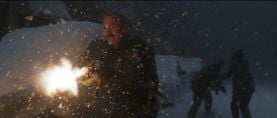
This approach is illustrated in one of the most critical scenes in Episode 1 ("Crossings"), which involves a violent robbery of a gang drug house perpetrated by the trio of friends who lead our story. Jeremiah is a firm believer that tension is not created through amplification, but by limitation. Following this creed, we wanted to limit the perspective of the viewer by remaining close to our antihero Robbie (Tom Pelphry) as he makes his way methodically and violently through the house.
We attempted to shoot the scene in a single shot using the Alexa Mini LF and a 28mm Canon FD lens. The Mini LF’s ability to fit in small spaces, while providing the intangible depth that comes with the larger sensor, made it perfect for this situation. The 28mm kept us close to Robbie, giving an intimate feeling while still revealing his surroundings. Although the final edit used limited cuts to shorten the action, this single-shot approach necessitated that I light the entire house to be seen in 360 degrees.
Designing the Set For 360-Degree Coverage
Once our concept took shape, Jeremiah and I worked with our brilliant production designer Keith Cunningham to create a set that would feel believable as a small run-down drug house, but with enough room to move around the action in one shot. It was a delicate balance, because we needed space to shoot, but we also knew that our single-shot approach eliminated any possibility of “hiding” how big the space really was. To find the proper balance, we used tape on our stage floor to walk out the timing of the action in prep, measuring exactly how much room we would need for the camera and crew. Additionally, we carefully laid out the furniture to allow for our stunt coordinator Justin Riemer’s stunts to flow smoothly throughout. This careful prep allowed us to build the set as small as possible, selling the environment as cramped and dilapidated while still accommodating the camera.

Going Handheld
Throughout the shoot, Jeremiah and I favored a handheld camera over Steadicam or dolly, as we felt it provided an immediacy and honesty that reflected our characters and their experience of the world. Accordingly, A-camera operator Stew Cantrell captured the action handheld, working carefully with the actors and the stunt department to tweak the action and the timing so that the camera was always in the right place at the right time. Focus puller Troy Dobbertin kept it sharp, and dolly grip Chris “Chappie” Chapman steered Stew around our furniture as he walked backward through the space.
Lighting an Urban Night
I wanted the scene to be dark, but I always strive to put a range of luminance in every shot to avoid “muddy” darkness. With this in mind, I had Keith place windows in particular orientations to silhouette our characters as they made their way through the dark house. We tested various window treatments and ended up using a mix of blinds and cheap fabrics, hitting them from the outside with Arri T5 and T2 5K and 2K tungsten fresnels and Rosco E-Colour 179 Chrome Orange gel to simulate sodium-vapor streetlights.

Whenever it’s appropriate, I favor the orange glow of sodium vapor in urban nights. It allows for color contrast when mixed with cooler ambient light, which gives the night some life and color all while retaining a gritty feeling. It’s harder to justify these days, as most cities are moving toward (boring!) white LEDs, but in the ramshackle environments that Task inhabited, sodium felt right. Gaffer Bill O’Leary and I also used a mix of practicals inside — everything from fluorescent stovetop lighting in the kitchen to purple LED Literibbon in a reptile terrarium to create further color contrast. All of these practicals were connected back to our dimmer board operator Alex Rizzo, who controlled selected units in real time during the shoot. This helped avoid shadows and flat frontal lighting as the camera crew and actor moved through the space.

Collaboration in the Dark
All three of our robbers wear dark clothes and masks, beautifully crafted by our costume designer, Meghan Kasperlik. Robbie’s mask was particularly striking, but it required careful side-lighting to bring out its texture and create contrast. This presented a challenge during the bedroom confrontation with one of the dealers. To illuminate Robbie’s mask without revealing the source in the long, continuous shot, we positioned an electrician in the bedroom with a 2' Astera Helios tube light, crouched just below frame as the camera passed overhead. As the camera swung around into Robbie’s close-up, he rose and subtly adjusted the light into position while Alex Rizzo dimmed it up on his board.


Scenes like this encapsulate the collaborative nature of filmmaking — every department bringing their A-game to execute an ambitious idea. But more than that, the scene reinforced the guiding principle we set from the beginning: Perspective is everything. By staying rooted in Robbie’s experience, the sequence finds its tension not in spectacle, but in proximity — in what we see and what we don’t.

Alex Disenhof, ASC earned the 2026 ASC Award for Episode of a One-Hour Regular Series for his work on this episode of Task, entitled "Crossings." Disenhof shared this honor with Christophe Nuyens, SBC (Andor, "I Have Friends Everywhere"), as voting in this category resulted in a tie. See the full list of 2026 winners here.
Images courtesy of HBO and the filmmakers.