A Knight of the Seven Kingdoms: Capturing the Series' Epic Trial of Seven
Cinematographer Gustav Danielsson, FSF on crafting muddy, misty atmosphere and subjective combat for the intense battle sequence featured in Episode 5 — all on a leaner budget than the show's predecessors'.
When Ser Duncan the Tall ("Dunk," played by Peter Claffey) — the clumsy, honorable and resilient protagonist of the Game of Thrones series A Knight of the Seven Kingdoms — was forced into a seven-on-seven battle against a group of the kingdom’s best knights, viewers were wholly immersed in Dunk's perspective as he faced down death. Through jarring POV shots and palpable atmosphere, Swedish cinematographer Gustav Danielsson, FSF and director Owen Harris anchored Episode 5's indelible action sequence in the unfolding carnage of this "Trial of Seven."
Speaking with American Cinematographer, Danielsson details the making of this major moment in the Game of Thrones world, which called on him to give the scene a naturalistic, yet threatening feel; cover the battle with a range of perspectives, cameras and rigs; and align audiences with the anxiety of the scene's hero. The cinematographer also shares how he and Harris aimed to set A Knight of the Seven Kingdoms apart from its predecessors, and his thoughts on the episode's glowing reception.
American Cinematographer: How did you come onto the project, and what was your prior relationship with director Owen Harris?
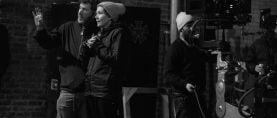
I worked with the director, Owen Harris, before. We’d done three Black Mirror episodes: "Be Right Back"(Season 2, Episode 1), "San Junipero"(Season 3, Episode 4) and "Striking Vipers" (Season 5, Episode 1). We also collaborated on other series, like Brave New World and Troy: Fall of a City, and on some features, like Kill Your Friends and Gamechangers. After Owen got onto A Knight of the Seven Kingdoms, he just sent me a WhatsApp text: “Do you want to do it?” I loved the old Game of Thrones stuff and I had just rewatched all the seasons with my family. My family was all very excited and said I had to do it, no questions. So, I went to Belfast, Northern Ireland. Most of the show is shot on location close to Belfast, and the interior sets were built at Titanic Studios in Belfast.

What was your overall visual approach to the series, and how did you want it to differ from the original Game of Thrones?
I think one of the reasons they chose Owen as a director is that they wanted someone to approach things differently on this. Our prior work together on Troy: Fall of a City involved a story set in ancient Greece, so he and I had done a period piece before — but it definitely wasn’t our specialty. The whole series has a different tone than the original Game of Thrones. The story is more intimate and character-driven, and they wanted him, as a lead director, to set the tone; he has proven his ability to combine character-driven story with strong visual storytelling.
One of the main differences compared to Game of Thrones is the humor in A Knight of the Seven Kingdoms. The show starts out quite humorous in the beginning and gradually becomes darker as the season progresses. Another key difference is scale. This is a story about a simple hedge knight, not about kings and dragons. It is a smaller-scale show with a more modest budget, but that actually suited our story very well. We had some fantastic sets to work with, as well as the absolutely majestic Northern Irish landscape, which really helped emphasize the smallness of the characters against the the world around them.
We wanted the series to feel naturalistic and earthy in its visual approach — not feel too lit or artificial. That was the main principle. We wanted to steer away from fancy camera moves that would take you out of the characters’ world. Until the fight in Episode 5, all the shots were off cranes or dolly.

I really like how the original Game of Thrones looked — it was very effective for what they were trying to achieve — and I think we’ve found a nice visual tone for what we’re doing on A Knight of the Seven Kingdoms.
For the Trial of the Seven sequence — featured in Episode 5, entitled “In the Name of the Mother” — what was your guiding visual concept?
One of the ways we tried to capture that feeling was that the whole fight sequence — and what leads up to it — is basically all shot in mist and early-morning light. It’s just gray and grim. It sounds simple, but I think that makes it foreboding and adds to the feeling that this is not going to end well. The scene presents a very dark moment for Dunk. But we also wanted the audience to feel that Dunk might be about to die. That’s something Game of Thrones has been famous for: Even your hero can die in an episode like this. So, our whole look pointed toward that.
Irish weather is quite harsh. The country has incredibly beautiful landscapes, but the weather changes so quickly, which makes it difficult to maintain a consistent look. To control the sun, we used four 20'x12' fly swatters rigged with either full black or double black nets, as well as Half Silent Grid, depending on the conditions. We shot the sequence over two weeks, and the weather was constantly shifting.
Our gaffer, Seamus Lynch, had the frames mounted on genie booms fitted with caterpillar tracks so they could move through the muddy battlefield. Creating this soft morning atmosphere with mist and without harsh sunlight was a real challenge.
We then filled the arena with smoke. Some of it came through long, lay-flat smoke tubes that the SFX floor supervisor Tom Lloyd placed upwind to create an even layer of fog across the battlefield. But the wind direction was constantly changing, so a large amount of the atmosphere also came from handheld Artem units that the SFX team were running around with throughout the set. The visual-effects department, led by VFX supervisor Aaron Roebuck, did an incredible job cleaning up and matching the smoke across a huge number of shots.
I think the choice to shoot this fight in the dim morning light, together with the mist and the muddy ground, was what made the shoot really hard — but I’m really satisfied with how it paid off. It really adds mood to the sequence.

The subjective nature of the sequence makes it very immersive. How did you develop a camera language that would help achieve that?
The fight is shot from Dunk's perspective — close to him, handheld most of the time. We only show the geography briefly, in wider, steadier shots. Some of the wider shots are from Egg's point of view: He looks at his friend, the knight, and is fearing his death. So, that was an important perspective. But most of the time, you’re in Dunk’s world, and you can’t really see anything outside of it. Dunk doesn’t even see what’s going on on the rest of the field — especially when he’s got the helmet on, and because of the fog.
The armor the characters are wearing is heavy, and from their perspective, you almost don’t see anything except through that little slit in the visor. So, for Dunk’s perspective, it was really important to have a sense of grittiness — to show how unpredictable the combat is, and how quickly things can pop up out of the smoke and into this tiny slit of vision. We tried to give the viewer the feeling of being in the armor yourself. I think that perspective is really good for this fight — it's claustrophobic and disorienting.
The helmet POV shot was executed by our 2nd unit with a DJI Ronin 4D — basically a very small camera on an arm that is completely balanced. You can unhook the camera body, so you only have that little camera on a small arm. It’s lightweight and stabilized. The camera was then mounted inside the visor of a helmet and was operated by our stunt coordinator Florian Robin. It was one of those situations where we had just the tool we needed to get our shots.
What comprised the rest of your camera and lens package?
I chose the lenses before I chose the main show camera: I wanted to shoot on Panavision Ultra Panatar anamorphic lenses with a 1.3 squeeze. These lenses are very elegant and a little soft, but in a very subtle way. They are quite rare, so Dave Doyle at Panavision Ireland had to contact colleagues in different parts of the world to assemble two complete sets. For some night scenes, we used Panavision's VA series.
For most of the show, we used two Arri Alexa Mini LF cameras, shooting 4.5K 3:2 Open Gate. The Ultra Panatar lenses cover a larger format, which is why I chose the Mini LF over the Alexa 35. The show’s aspect ratio is 2:1, which makes the anamorphic squeeze of these lenses almost perfect for filling the sensor.
Originally, director Owen Harris and I wanted to shoot the show in CinemaScope, but HBO would not allow us to go wider than 2:1. In hindsight, that worked very well for the show, given the height difference between Dunk and Egg.

How did you balance different camera techniques — handheld, crane and Steadicam work — within the sequence?
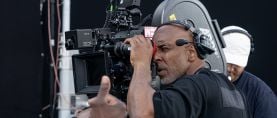
We had one camera on a Scorpio 45' with an all-terrain base, which turned out to be very effective — especially because we were on a muddy field. When it came to filming horses, it was very efficient to shoot on the crane; we could get the right height easily and move people around accordingly. There were a few Steadicam shots, but when we went into action, most of the rough, close coverage was handheld.
This whole sequence was thoroughly storyboarded. Every shot was in the boards, and we discussed it for months with Owen, showrunner Ira Parker and 2nd-unit director Rob Inch. It was a long planning process.

Our A-camera operator, Sebastian Barraclouogh, was brilliant operating the camera on the Scorpio together with key grip Matt Budd and B-camera operator Peter Byrne. And most of our handheld work on the fight was operated by stunt coordinator Florian Robin.
The sequence includes a push that moves into Dunk's helmet. How was that achieved?
The shot was executed by our excellent 2nd-unit team, using a wire cam. We had the camera rigged on a cable system, allowing us to send it across the set quickly while precisely controlling its height. A wire cam was really the only setup capable of executing a shot like this; it combined speed, long-distance travel and precision. We then used a hidden cut to push into the helmet POV.


Did you use any visual effects in the sequence?
We didn’t use much greenscreen in this sequence, largely thanks to the use of smoke. The smoke was partly a budgetary decision, used to help conceal the large audience surrounding the fight. A Knight of the Seven Kingdoms didn’t have the same massive budgets as its predecessors, Game of Thrones and House of the Dragon, so we had to make decisions based on doing more in-camera.
The VFX department did a massive job cleaning up all the inconsistencies in the smoke, as well as adding and fine-tuning more smoke. I’m really thankful that they ensured all their work feels completely invisible, as if it was captured entirely in-camera. That goes for all of the VFX in the show. That work was led by VFX supervisor Arron Roebuck and VFX producer Paul Russo, and created by the company El Ranchito.

This episode became the series’ highest-rated episode on IMDb, and remains one of the highest-rated in television across the site. How did it feel for the episode to achieve that level of resonance with viewers?
I mean, it’s great. It’s now been one and a half years since I shot this. At some point, I started thinking, “Maybe this is good,” but it’s hard to tell until you show it to an audience. No one really knew how well it was going to turn out. We were also competing with one of the greatest shows — the original Game of Thrones — which is a high bar to live up to. But when the reviews started coming, I was like, “Wow, this is insane.”
This was a really tough shoot — especially for the scale of what we wanted to achieve. We were a bit ambitious, so it’s really nice that after we worked so hard on something, it turned out that people like, or even love it.
Unit stills by Steffan Hill. Images courtesy of HBO and the filmmakers.